Accessibility includes physical, communication, digital, and organizational aspects.
Examples of barriers by area:
| Physical | Steps, missing tactile guidance systems, poor lighting, etc. |
| Communication | Texts that are difficult to understand, lack of sign language interpretation |
| Digital | Insufficient color contrast, screen reader incompatibility, missing text alternatives, etc. |
| Organizational | Staff-related barriers (uncertainty wheb interacting with people with disabilities, lack of accessibility knowledge) as well as structural barriers (processes, rules, responsibilities, internal communication) |
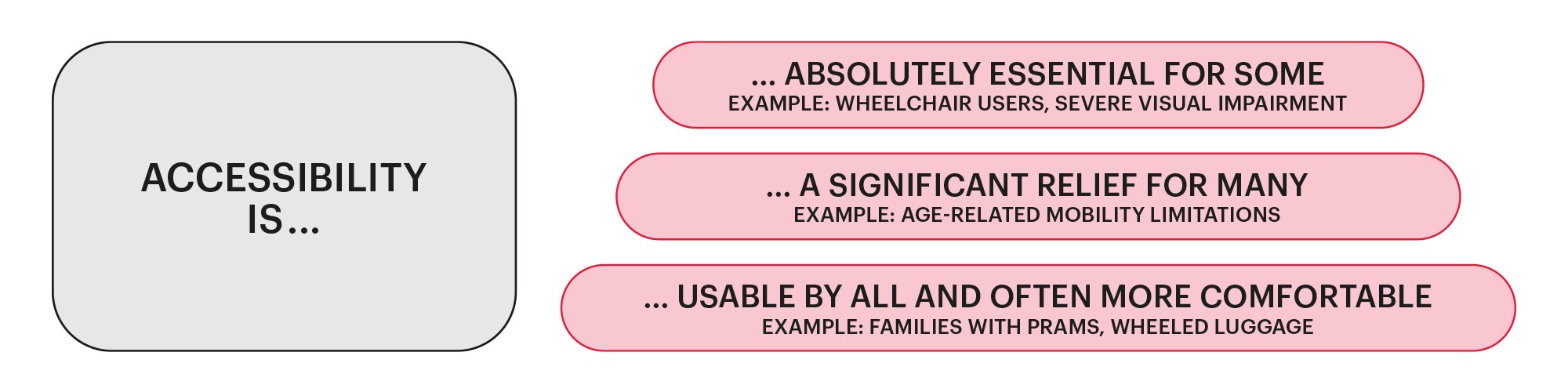
Accessibility means designing products, services, spaces, information, and communication so that they are:
usable by as many people as possible
accessible independently wherever possible
easy to find, understand, and navigate
supported by an open, respectful, and welcoming attitude
The goal of accessibility is to design services and experiences so that as many people as possible can use them independently and without unnecessary — ensuring equal access to products, services, buildings, and information. No one should be excluded because of a physical, sensory, or cognitive disability.
In practice, fully accessible design for every situation is not always achievable. What matters is recognizing barriers early, avoiding them where possible, and reducing them step by step — making offerings and services as accessible as possible.
The legal framework — in particular the Federal Disability Equality Act (Bundes-Behindertengleichstellungsgesetz) and the Accessibility Act (Barrierefreiheitsgesetz) — defines binding accessibility requirements. According to the UN Convention on the Rights of Persons with Disabilities (UN CRPD), persons with disabilities include people with long-term physical, mental, intellectual, or sensory impairments which, in interaction with various barriers, may hinder their full and effective participation in society on an equal basis with others.
Barriers often result from the way spaces, information, or processes are designed and can be reduced through targeted adjustments.
Further information on legal requirements is available in the module Legal Framework & Standards.