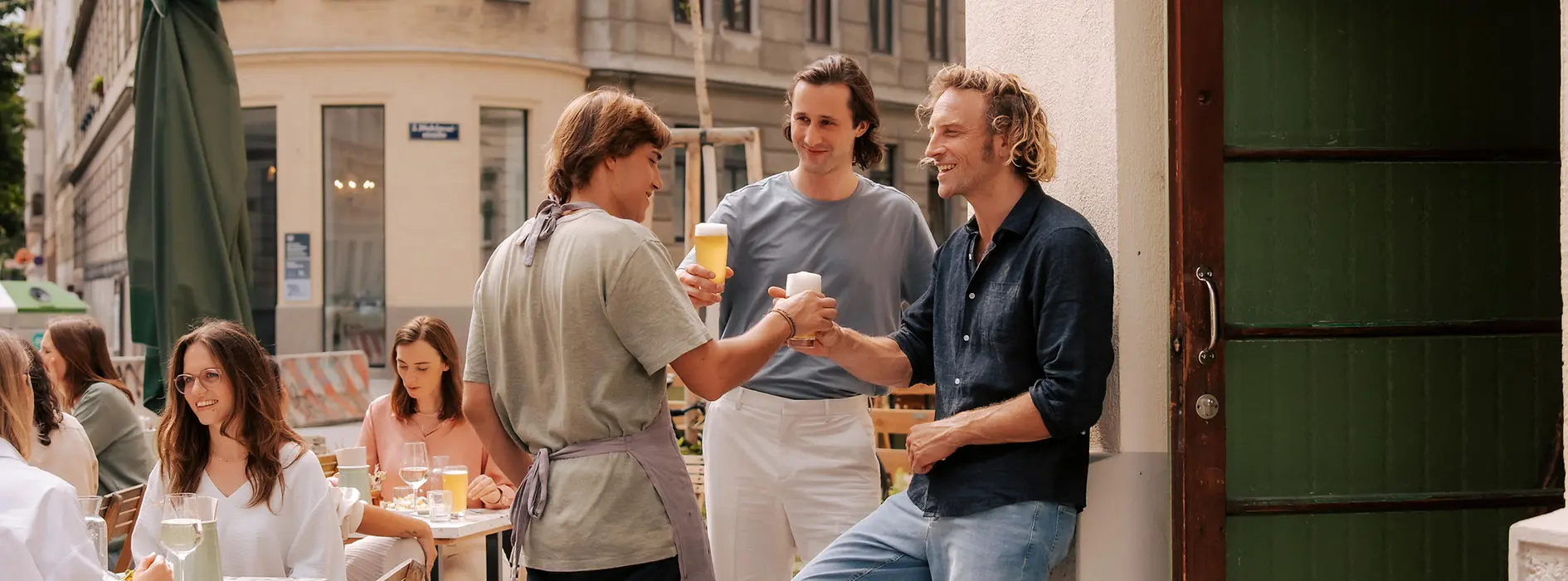
Welcome, Arrival & Seating
An accessible dining experience starts with a warm welcome and seating that works for different needs. The following aspects should be considered:
Core Requirements
| Clear communication | Address guests directly and communicate in an easy-to-understand way |
| Individual accessibility needs | Ask about individual needs at the welcome |
| Wheelchair-accessible tables | Provide tables of adequate size with knee clearance (at least 60 x 80 cm, 70 cm height) |
| High tables | Use high tables only as an additional option, not as the seating choice, as wheelchair users and people of short stature cannot use them comfortably |
| Room acoustics | Actively improve room acoustics to reduce background noise |
| High-contrast design | Design furniture and tableware with strong contrasts to facilitate orientation |
Practical Tips
| Personal welcome | Welcome guests personally, accompany them to their table and ask whether they have specific accessibility requirements, such as access to a digital menu – this ensures all guests feel equally valued. |
| Flexible seating | Depending on the size of the venue, keep at least 2–3 tables with knee clearance free of fixed seating or readily available – allowing wheelchair users to be seated flexibly. |
| Chairs with armrests | Provide chairs with armrests – these offer support when sitting down and standing up for people with mobility impairments. |
| Alternative seating heights | Where high tables are used, offer an equivalent alternative at standard height in the same area – so wheelchair users and people of short stature can reach everything on the table and take part in conversations at eye level. |
| Orientation in the dining area | Use high-contrast interior and table design – this helps people with visual impairments orient themselves more easily in the venue and recognise food, cutlery and tableware on the table. |
| Table availability | Where guests choose their own seats, reserve an easily accessible table with knee clearance for guests with disabilities – ensuring a suitable solution can be offered immediately when needed. |
| Improved acoustics | Improve room acoustics with wall panels, curtains or large decorative elements – allowing all guests to take part in conversations more easily. |
| Assistance dogs | Welcome assistance dogs, recognise them as an important support, and provide water bowls. |
Communication is key – Further guidance on inclusive communication is available in the module "Accessibility Essentials".