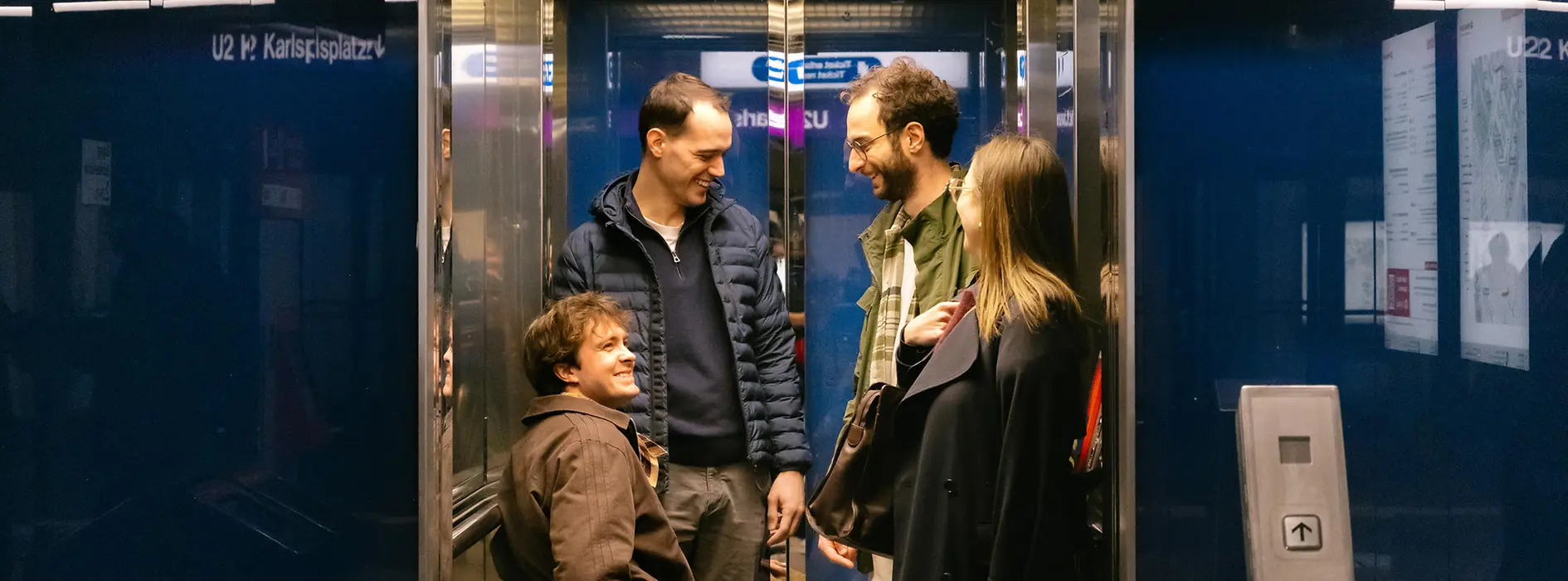
Elevators and Vertical Access
An elevator connects more than floors — it determines whether guests can move through the building independently. (in accordance with ÖNORM EN 81-70)
Core Requirements
| Elevator car size | Minimum of 110 × 140 cm (Type 2), minimum door width of 90 cm |
| Controls | At an accessible height (ideally approx. 85 cm), with sufficient distance from the door (at least 50 cm) |
| Buttons | Tactile labelling (raised characters and Braille) and high-contrast design |
| Maneuvering space | At least 150 × 150 cm in front of the lift |
| Orientation | Floor indicators should be both visual and audible. |
Practical Tips
| Improve controls | Check whether controls are clearly visible and high-contrast. If tactile markings are missing, they can be retrofitted quickly — significantly improving independent use for blind guests and guests with low vision. |
| Support orientation | Install a mirror on the rear wall or opposite the door. This allows wheelchair users to see while reversing and exit the elevator safely. |
| Secure the emergency call | Test the emergency call regularly and make sure clear feedback is provided. Ideally, use a solution that is also usable by deaf guests — for example a visual display or text function (intercom with screen). |
| Provide visual and audible information | Check whether both audible announcements and visual displays are available. Only the combination enables independent use for both blind and deaf guests. |
| Communicate safety clearly | Supplement the notice “Do not use in case of fire” with information about safe waiting areas. This is particularly important for guests who cannot use stairs independently. |