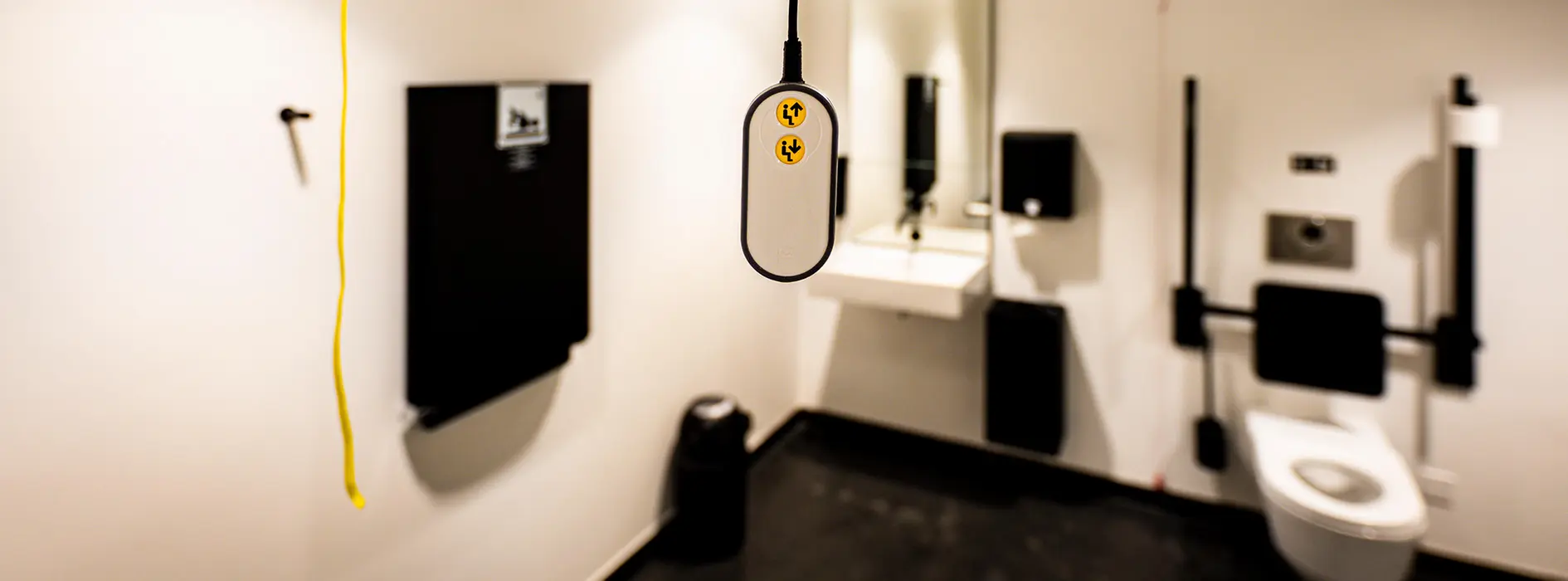
A well-planned bathroom enables independence, safety, and comfort. Clear layouts, sufficient space, and fixtures that are easy to reach are essential for independent use.
Core Requirements
| Shower | Level-access, slip-resistant, and at least 150 × 150 cm. |
| Shower seat | Fold-down, seat height 46–48 cm, sufficiently load-bearing (min. 150 kg). |
| Grab rails | On both sides at the WC and in the shower area, stable and high-contrast, sufficiently load-bearing (min. 150 kg). |
| WC | Seat height 46–48 cm, with fold-up support rails on both sides. |
| Washbasin | Underride-accessible with at least 70 cm knee clearance, maximum top edge height 80 cm. |
| Mirror | Usable from 85 cm height up to approximately 180 cm. |
| Door | Opens outward, unlockable from outside, at least 90 cm wide. |
| Emergency call | Emergency pull cord reachable from the WC and from the floor: positioned approximately 10 cm above floor level. |
Practical Tips
| Emergency call system | Install the emergency pull cord or button so it is reachable from the WC and from the floor, just above floor level. The emergency call must provide both visual and acoustic feedback and be connected to a permanently staffed point to ensure every emergency call is received. |
| Contrast | Choose grab rails in a colour that clearly stands out from the background and ensure high contrast. This significantly improves usability for guests with visual impairments. |
| Reachability | Position taps, shelves, and the shower head at an easily reachable height (80–110 cm). This enables guests with limited arm mobility or wheelchair users to reach everything independently. |
| Night-time safety | Use a night light or a motion-sensor light for the route to the bathroom. This increases safety for all guests. |