Vienna Press Release – December 2025 New Year’s Eve the Viennese way
In Vienna, December 31 is usually spent with family or friends. Some seek the quiet of home, others the buzz of the city at elegant galas, club parties or open-air events around Stephansplatz. A lovely tradition is to give little good-luck charms to loved ones, such as four-leaf clovers, chimney sweeps, horseshoes, gold coins, fly agaric mushrooms or even pigs. These can be found everywhere at winter markets during the holiday season. Some are edible and made of chocolate or marzipan.
The custom of lead-casting promises a glimpse into the year to come. As far back as ancient Rome, small figures were melted over a flame on a spoon. They were made of lead; today, for health and environmental reasons, they are often made of wax. Once the figure has completely melted, the liquid is quickly poured into cold water, where the hot material solidifies again. The resulting shape can then be interpreted as various symbols and objects, which in turn are believed to foretell particular futures. People interpret either the abstract shape itself or its shadow in candlelight.
At midnight
Shortly before midnight, sparkling wine is set out so that everyone can raise a glass together right after the second-by-second countdown to 12:00 am. In Vienna, the toast is “Prosit Neujahr.”
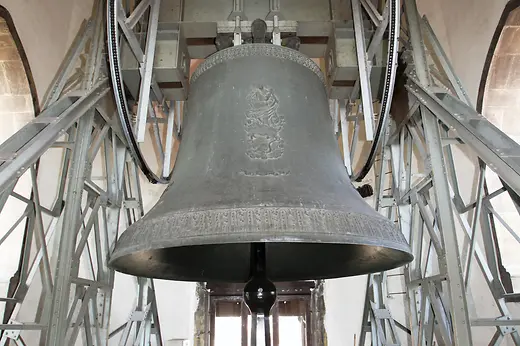
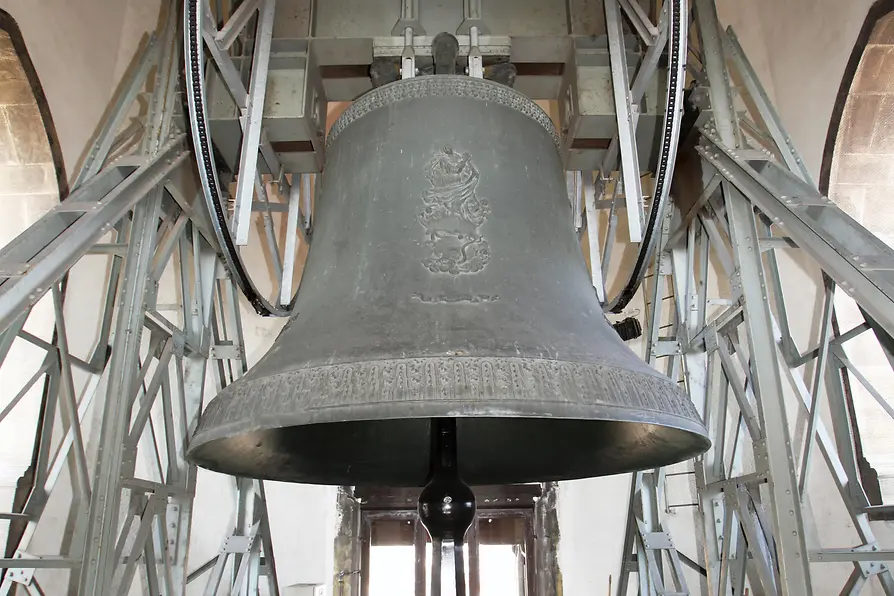
Right at the turn of the year, a very special bell called the “Pummerin” rings in the north tower of St. Stephen’s Cathedral. Its name derives from its deep, booming tone. At more than 21 metric tons, it is the largest and heaviest church bell in Austria and one of the largest worldwide. It is heard only on major public holidays and on special occasions such as a papal election. In 2026, the Pummerin will celebrate its 75th birthday. It was cast in 1951 in St. Florian, Upper Austria, after the old bell fell and broke during a major fire in 1945. The “Old Pummerin” was made in 1711 from abandoned cannons left behind after the Second Ottoman Siege of Vienna. The fragments were reused for the new bell as well. For that reason, and because of its recasting shortly after the Second World War, the Pummerin is still regarded as a symbol of peace and freedom.
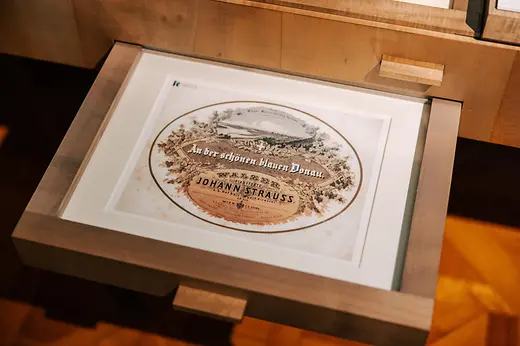
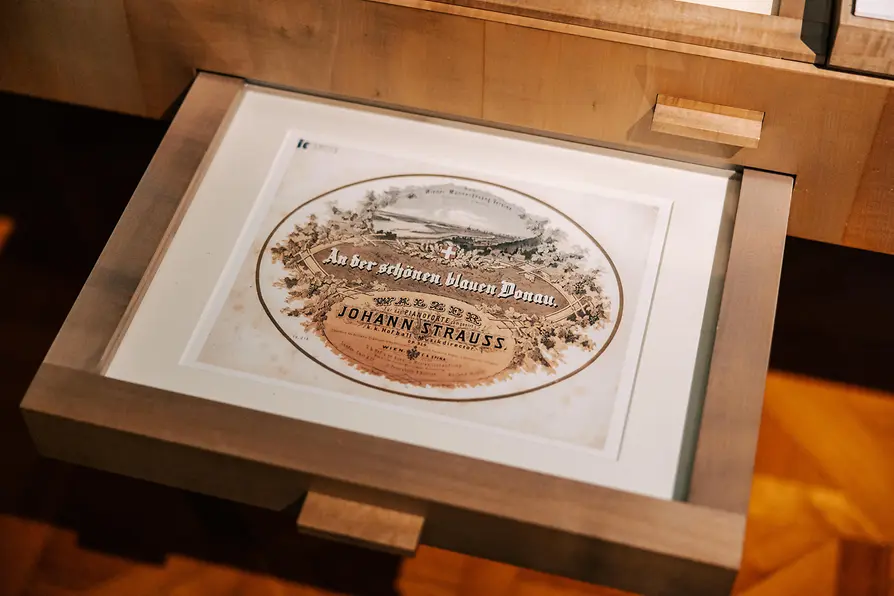
The ringing on New Year’s Eve at Stephansplatz, a stop on the New Year’s Eve Trail, the two-kilometer-long New Year’s Eve mile through Vienna’s historic center, is a special experience. The Austrian Broadcasting Corporation (ORF) traditionally broadcasts the Pummerin nationwide at midnight. It is followed immediately by one of the most famous works of classical music: the waltz “On the Beautiful Blue Danube,” or simply the Blue Danube, by Johann Strauss II. In Vienna, the new year is welcomed by dancing in three-four time.
New Year’s Eve and New Year’s concerts
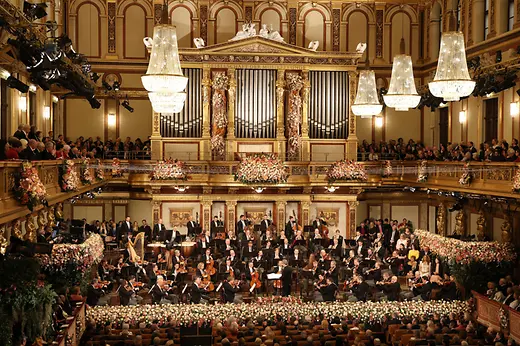
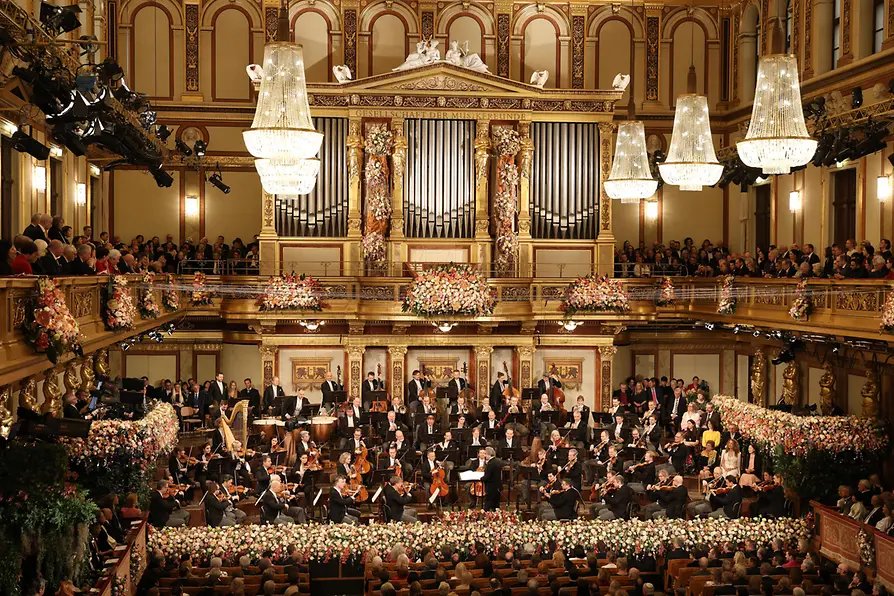
Around the turn of the year, Vienna hosts an especially large number of concerts. The most famous is the Vienna Philharmonic’s New Year’s Concert in the Golden Hall of the Musikverein. It begins on January 1, 2026 at 11:15 am Central European Time. A program that changes every year but which focuses on the Strauss era of the 19th century concludes with two traditional encores: the Radetzky March by Johann Strauss I and the Blue Danube Waltz. In 2026, Canadian conductor Yannick Nézet-Séguin will lead the concert. The live broadcast draws around 50 million viewers in more than 90 countries. Due to the huge demand, tickets are allocated by lottery worldwide each year.
As a result, most Viennese residents follow the concert either from their sofas or at open-air public viewings in spectacular settings at Stephansplatz or in front of the Giant Ferris Wheel in the Prater. The Museum of Applied Arts (MAK) will host a watch-along party for the first time on January 1, 2026, which is fitting given that the Vienna State Ballet’s interludes were filmed here (and in the Vienna Hofburg). These will be shown in the TV broadcast of the New Year’s Concert, accompanying two works by Johann Strauss II: Roses from the South and the Diplomats’ Polka.
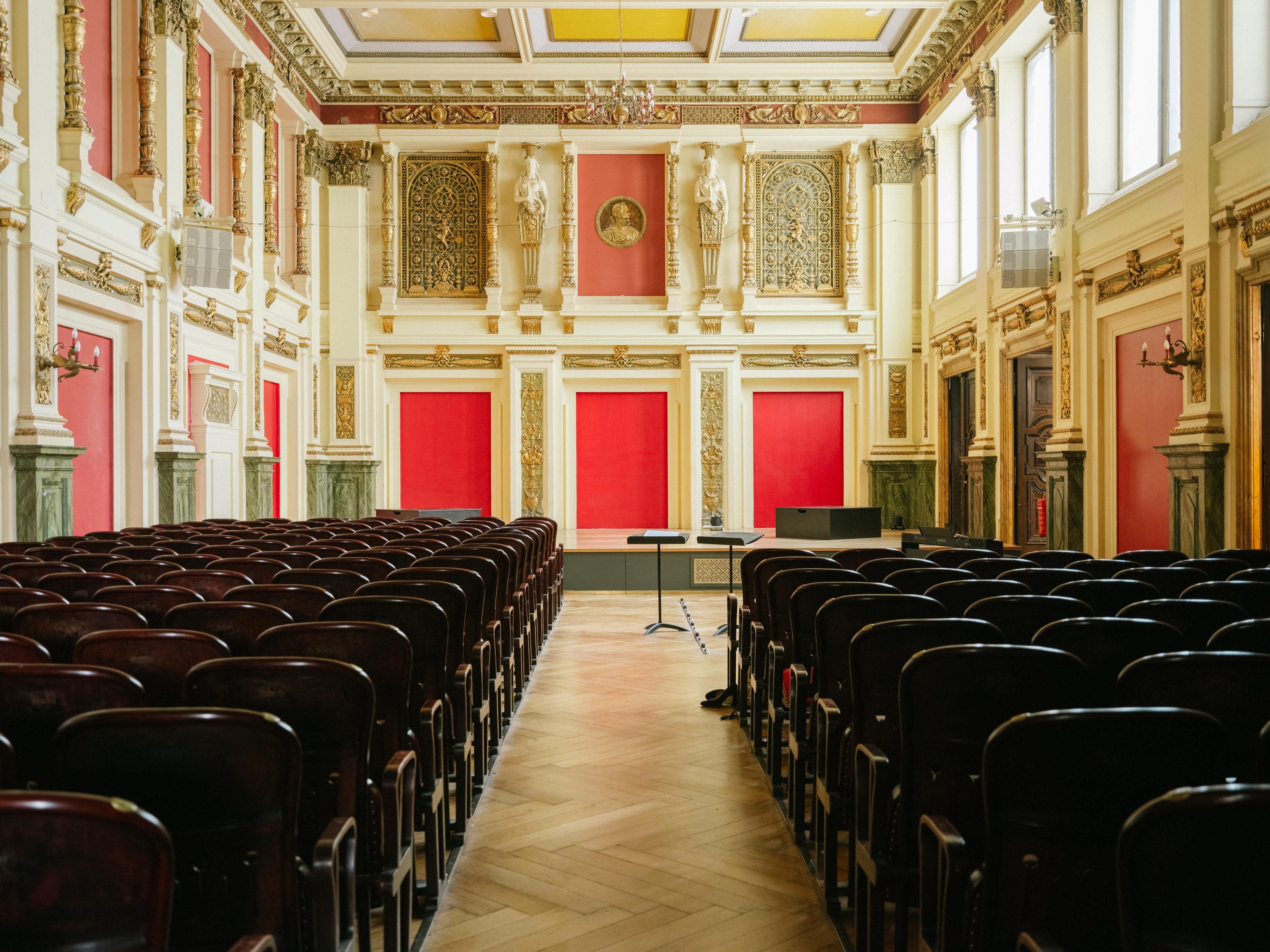
Several other concerts appear on Vienna’s schedules at this time of year, and tickets are easier to obtain than for the New Year’s Concert. For the past 50 years, the Vienna Symphony Orchestra has performed Beethoven’s monumental Symphony No. 9 at the Wiener Konzerthaus (Dec 30, Dec 31 and Jan 1). The New Year’s Concert of the Composers will take place in Ehrbar Hall for the third time on January 1, 2026.
Die Fledermaus, the most famous operetta in the world, is another fixture around New Year’s. Both the Vienna State Opera (Dec 31, 2025; Jan 3 and Jan 6, 2026) and the Vienna Volksoper (Dec 31, 2025 and Jan 1, 2026) will present Johann Strauss II’s masterpiece. It has appeared on New Year’s programs at various opera houses almost every year since 1900.
You can find even more New Year’s Eve and New Year’s concerts in our event database.


Download print-ready version
This image is not available for download
Download print-ready version
Download print-ready version
Download print-ready version
Sound of Pummerin Bell
© Wiener DommusikDisplay alternative text
Sound of Pummerin Bell © Wiener Dommusik
Contact
Helena Steinhart
Team Manager
+43 1 211 14-364
helena.steinhart@vienna.info